
The session that changed how I listen
Early in my practice, I worked with a woman who was doing everything I asked of her, yet her healing wasn’t moving the way either of us expected.
She was following the protocol, staying consistent, and doing everything right on paper. From the outside, it looked like she should have been making more progress than she was. Yet after our sessions, I kept leaving with a feeling that something wasn’t quite right. It wasn’t her commitment to healing that concerned me. It was something about what was happening between us in those conversations.
It took me a while to realize what was happening. Every time she started describing a symptom or telling me about a difficult week, my mind immediately jumped to solutions, next steps, and protocol adjustments before she had even finished speaking. I thought that it was my job to know things and to share them. The problem was that I wasn’t doing the thing she actually needed first.
What she really needed was for me to slow down, listen more carefully, and stay with what she was telling me before moving toward a solution. She needed room to finish her thoughts without me rushing to fill every silence.
When I finally did that, when I stopped preparing my answer while she was still talking, that was the moment, when everything changed. She started telling me things she hadn’t told me before, about her stress at home, about something that had happened years earlier that she had never connected to her health. Those were the things that mattered the most and where the real work was.
Looking back, some of the most meaningful moments I’ve experienced with clients had very little to do with supplements, lab results, or protocols. Some of those moments happened when a client felt safe enough to tell me something they hadn’t told anyone before, when they felt finally heard and seen for the first time. Others happened when someone realized they didn’t need to defend their symptoms, explain themselves, or convince me that what they were experiencing was real.
Many people with chronic illness have spent years searching for answers while feeling deeply misunderstood. For a lot of them, the healing journey has been lonely in ways that are hard to describe. That’s why being fully present with someone can matter more than we realize.
Holding space is not about having the right answer. It is about listening carefully enough to understand what your client actually needs and then meeting them there, instead of where you already decided they should be.
What holding space for a chronic illness client means

I hear people use the phrase “holding space” a lot, and most of the time, when I ask what it means in practice, people describe things like being kind, being supportive, or being encouraging. Those things matter, but they are not the same as holding space.
Holding space means giving someone your full attention. It means being more focused on understanding what they are sharing than on what you are going to say next. It means setting aside the protocol you prepared, your own expectations, and even your worries about whether you are doing enough, so you can be fully present with the person sitting in front of you.
It sounds simple, but it takes practice.
We come into sessions with ideas, with our knowledge and our training, and often we are already thinking about which tools we are going to reach for before the person in front of us has even finished telling us how they are doing. That is natural. But it is worth noticing, because the moment our attention moves from our client to our own thinking, the whole quality of the session shifts.
Most people can sense it, even if they can’t quite explain why. And when they sense it, they start giving us the shorter version of what is going on, the easier version. They stop going deep, because something tells them not to.
And sometimes we also come into sessions carrying our own worry that can be so loud: “Am I experienced enough for this?”, “Will I know what to say?”, “What if I miss something?”. That kind of internal noise pulls us further into our own heads and further away from the person we are trying to help. It also drowns out our intuition, which needs quiet to be heard and which is one of the most valuable tools we have.
Why chronically ill clients need safety before anything else
Most people with chronic illness have spent years being dismissed. They have been told their symptoms are stress, or anxiety, or just part of getting older, and they went to appointment after appointment and walked away feeling like no one was really listening. Many of them eventually stopped describing certain symptoms altogether because they had learned that describing them led nowhere.
By the time they come to us, a lot of them have forgotten what it feels like to be truly heard.
That history lives in the room with us during every session. It affects how much someone shares, how honest they are willing to be, and how openly they can receive what we offer them. A person who doesn’t feel emotionally safe enough to share will give us the surface level, tell us what they think we want to hear, and then we will be working with an incomplete picture without even knowing it.
Feeling understood is not something you can create in one session by being warm and welcoming. It is built slowly, through small consistent things like being on time, remembering what they told you last week without them having to repeat it, not interrupting, not finishing their sentences, not jumping to reassurance when they are in the middle of feeling something hard, and not making them feel like their symptoms are a problem you need to solve as quickly as possible.
A phrase I come back to often in my sessions is simply: “I hear you. I believe you. We don’t have to rush.” For many people with chronic illness, that is something they have never been told.
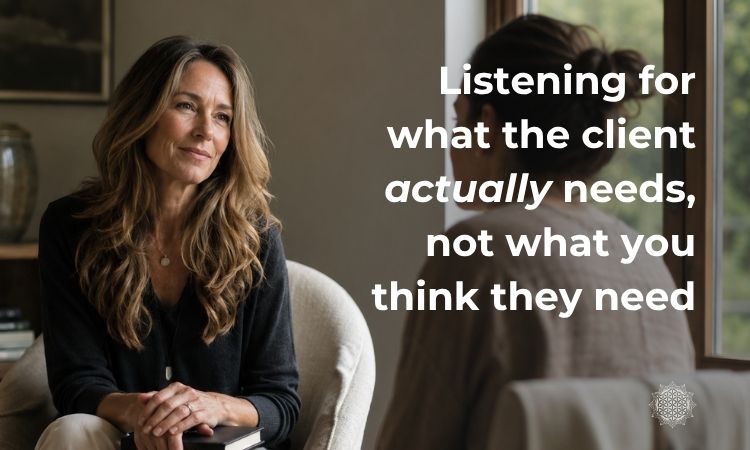
Listening for what the client actually needs, not what you think they need
This is something I’ve seen many times over the years, even with practitioners who care deeply about their clients.
A mistake I see often is assuming we already know what someone needs. We listen long enough to recognize a pattern and then move into solution mode, we already know what we are going to recommend, we are already thinking about next steps, but we stopped listening before they finished telling us the full picture.
A person may come to a session needing a protocol update, but other times they need something quite different. Other times they need reassurance that what they are experiencing is normal. In some cases they need permission to slow down and stop pushing so hard. Sometimes they need someone to help them simplify, because they have added so many things to their healing plan that they are overwhelmed and nothing is working anymore. And occasionally what they need most is simply to hear that healing takes time, and that showing up, even on a hard week, still counts.
When we stop listening and start assuming, we risk giving people what we think they need instead of what they are actually asking for. And those are not always the same thing.
Often, people already know what they need. They may not have the language for it yet or feel ready to say it out loud, but if we pay close attention, they usually show us. The answer is almost always already there somewhere in what they are sharing and our job is to be present enough to hear it.
In my experience, the people who help others heal most effectively often listen beyond the symptoms. They notice what someone is not saying as much as what they are saying, ask one more question before reaching for a recommendation, and are willing to let a session go somewhere they did not expect, because sometimes that unplanned place is exactly where the healing needs to happen.
I have had sessions where I came in with a full plan and by the end we had not touched a single thing on my list, because what the person sitting across from me actually needed that day was to feel heard. And that, just that was enough to shift something.
Staying curious, staying humble, staying open
After years of working with clients, there is a real risk that starts to develop: we begin to think we already know what is happening before someone has finished speaking. We hear a set of symptoms and something in us says, that sounds like heavy metals, or that’s clearly a nervous system pattern, and we start moving toward that conclusion without fully exploring what else might be there.
Sometimes we are right. But when we assume we already know someone’s story, we stop being curious about the parts we haven’t discovered yet.
The practitioners I have seen help people heal even in the most complex, long-standing cases are the ones who stay curious even when they think they already understand what’s happening. They pay attention to details, notice what doesn’t fit, and ask about things that others might overlook. In chronic illness, root causes are rarely obvious, and the detail that finally unlocks the healing is often the one that has been sitting there the whole time.
This also requires humility. Some of the practitioners who seem to help people through the most difficult cases are not necessarily the ones with the longest list of certifications. They are the ones who know how to be fully present with another human being, who can hold a theory loosely, who can be surprised by what a client shows them, and who are willing to explore what the client is showing them instead of forcing everything to fit into a conclusion they already made.
And it requires trusting your intuition, that quiet sense in the middle of a session that something is being left unsaid, or the pull toward a question you hadn’t planned to ask. Intuition speaks quietly, and it shows up when we are calm and present, not when we are busy trying to prove ourselves or rushing to fill the silence.
People can feel when we are distracted, worried about saying the right thing, or simply not fully present. The more grounded and present we are, the more supported they feel, and that is why taking care of our own inner state is not a luxury, it is part of the work.
Holding hope when clients have lost it
Chronic illness takes a lot from people over time, their energy, their plans, and eventually, for many, their belief that things will ever get better. By the time many clients come to us, they have tried many things, had moments of hope that didn’t last, and been disappointed enough times that they are carrying whatever belief they have left very carefully.
Something a practitioner can offer in those moments is to hold the vision of that person’s healing steady, quietly, without dramatizing it. Even when they cannot hold it themselves. Not false optimism, not pressure, just a calm and unshakeable trust that this person’s body has the capacity to heal, something they feel through the way you show up for them, session after session.
Sometimes our role is simply to carry that belief until the client is strong enough to carry it themselves.
What the work actually is
Every practitioner who does this seriously learns at some point that the protocol is not the whole work.
The protocol matters enormously, and I would not do this work without it. But the healing relationship is what makes the protocol land. A client who trusts you will tell you when something is not working, while someone who doesn’t will quietly stop doing the things that aren’t helping and never say why. And then neither of you will understand what is happening.
I don’t think we realize how much it means to someone with chronic illness to finally feel heard.
Years later, people may not remember every recommendation you made, but they often remember how they felt in your presence. What people often remember is feeling heard, believed, and safe enough to be honest about what they were going through.
And sometimes that becomes part of the healing too.
That is the work.
To your peace and happiness,
Muneeza