
Do you remember that infamous slap from Will Smith during the 2022 Academy Awards broadcast?
Comedian Chris Rock made a joke about Smith’s wife, Jada, who suffers from advanced hair loss, saying he couldn’t wait to see her in G.I. Jane 2 – a dig about her shaved head. Smith then walked onstage and slapped Rock hard across the face.
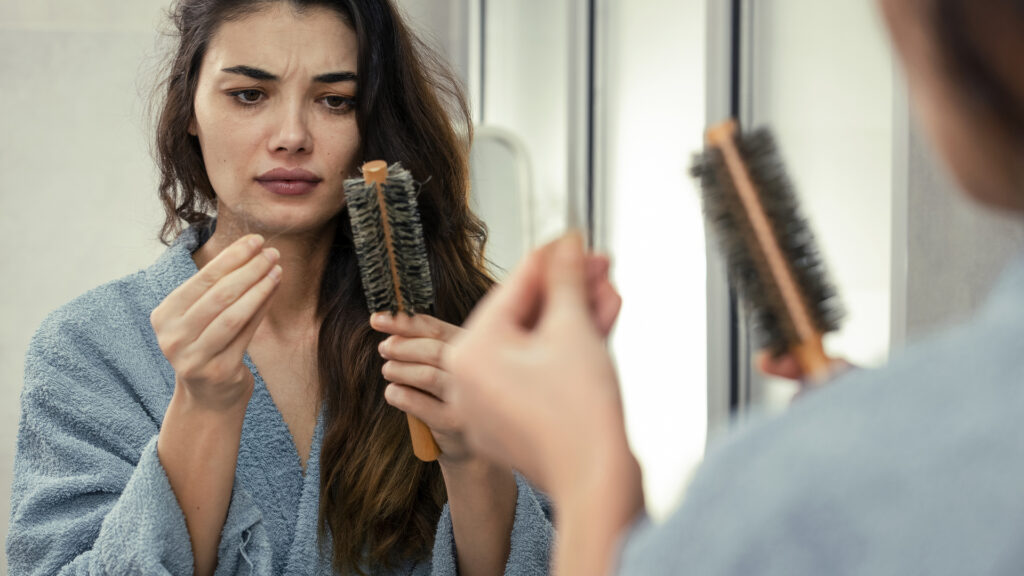
While Smith’s actions were reprehensible in the face of a benign joke, hair loss among women is no laughing matter. It has been increasing steadily for years.
AN EPIDEMIC OF HAIR LOSS IN WOMEN
According to a study in the Journal of the American Academy of Dermatology, 40% of women by age 50 experience hair loss, and the mainstream is taking notice. Magazines like Vogue, Allure, InStyle, and more are exploring why more and more women experience hair thinning, losing clumps at a time, and lacking vitality in their hair.
As many as 50% of men experience hair loss by age 50. According to multiple studies, as much as 95% of male hair loss stems from Common Male Pattern Baldness, one of the few genuinely genetic conditions (keep reading for more on the myth of genetic health problems). But historically, women did not come close to these levels.
So what changed? What is driving increased hair loss in women? And how does it differ from men’s hair loss?
Establishment medical organizations like The Mayo Clinic and Harvard Medical School pretend they have all the answers and authority on hair loss in women.
5 LIES ABOUT HAIR LOSS: WHAT THE “EXPERTS” SAY
There are many theories as to the underlying causes of female hair loss. Unfortunately, most of them are only that – theories – with little evidence to back them up. Let’s explore five of the most common theories and why they fall short of offering true insight into the cause of hair loss in women.
- Genetics is the most common root cause the medical establishment uses when health conditions are not fully understood. In other words, instead of saying, “We don’t know,” the medical establishment blames our genes – essentially blaming our bodies – for their lack of understanding as to the cause of any given condition.Genetics is the perfect scapegoat when no other answers exist. Who can argue with something as complex as genetics? It sounds smart to say our genes are to blame when it’s anything but. What’s confusing is that hair loss is one of the few realms of health where blaming genetics makes sense because male pattern baldness is almost certainly inherited.In a world where the blame for everything from cancer to diabetes to neurodegenerative diseases is genes, we should be careful to point at genetics as the cause of so many other conditions, including female hair loss. This is especially true as doctors barely consider factors like stress, nutrition and diet, lifestyle, and chronic viral illness, if at all.Are we supposed to believe that our genes are responsible for the astronomical rise in chronic illnesses over the last 60 years? So, our genes only went ‘bad’ in the previous 60 years? This doesn’t add up.
- Hormone disruption and menopause are two more mainstream culprits. Blaming any health condition or symptom on hormones is classic gaslighting perpetrated on women from birth.“It’s your hormones.” In other words, you’re sick because you’re a woman. Men have hormones, too, yet how often do you hear male health problems tied to hormones? Sure, female hormones shift through various phases of fertility. Still, it’s not a viable explanation for all the health challenges linked to this natural process in today’s world, including hair loss.“Because hormones” has become a catch-all when explaining hair loss in women, pulling in all hormone-related conditions like pregnancy, birth, menopause, and aging (just check out this article from WebMD). These theories don’t point out the mechanisms behind aging or menopause.One thing that this theory gets right, however, is that the health of our hormone-producing glands is involved in hair loss. More on that below.
- Autoimmune disease is another popular explanation for alopecia – the common diagnosis used to describe hair loss in women. The autoimmune theory states that the body is attacking its hair follicles, but no study has ever demonstrated this taking place. In other words, we have no proof of the body attacking itself, hair follicles, or otherwise.If someone shows me clear evidence that the body attacks itself in any way, I might accept that this theory is worth considering. I am still waiting to see that evidence.
- Physical manipulation of hair is another theory that explains the underlying causes of hair loss in women, and practically-minded practitioners developed it. Fingers are pointed at wearing hats too often, shampooing the hair too much, or pulling a ponytail too tight consistently.This theory falls apart quickly in the same way that the genetic blame game falls apart. Women have been styling and manipulating their hair in hundreds of ways for thousands of years, including wearing hats and pulling hair tight.Why would it be that our scalps are suddenly becoming hypersensitive to manipulation? In the last half-century, our genes and hairstyles suddenly caused harm, whereas before, they were harmless. I’m not convinced.
- Medications and toxic chemicals as a primary cause for hair loss are the one item on this list backed up by plenty of evidence. It’s well-known and well-documented that chemotherapy treatments cause a condition known as anagen effluvium (hair loss due to hair follicle damage), as do harsh chemicals used for various hair treatments.Paraphenylenediamine is a carcinogenic substance added to conventional hair dyes; it is just one of many harsh chemicals in everyday beauty products.The lie here isn’t due to inaccuracy – these substances cause hair loss. The issue comes from the medical establishment pointing to these as a significant cause while ignoring the true underlying causes.
HAIR LOSS: WHAT’S REALLY GOING ON
While the medical establishment points to several potential roots, just a few concrete factors play into hair loss in women.
When it comes to hair loss in women, the most significant factor we should be talking about is the health of the adrenal glands. Globally-known and respected health author Anthony William (the Medical Medium) writes that these glands produce dozens of different hormone blends that regulate our bodies, including the hormones that regulate hair growth.
When the adrenal glands are weak (a chronic condition in our stressed and caffeine-fueled world), they cannot produce the proper amount of hair-growth hormones, and our scalp shows the signs.
Weak adrenal glands are the actual cause of pregnancy and birth-related hair loss. It requires a tremendous amount of adrenaline for a woman to give birth, which can take a significant toll on the adrenals if factors like stress, poor diet, and a weak immune system are also in play. In these cases, thinning or disappearing hair can manifest months or even years after birth.
Another major factor in hair loss is a weakened liver struggling with a lifetime of toxins. The liver performs thousands of chemical functions in the body. When it loses its vitality, its ability to carry out all those functions diminishes, leading to rapid aging and decreased skin, hair, and nail health.
Viral pathogens like the Epstein-Barr virus can also reside in the thyroid and liver, disrupting the body’s ability to produce and regulate hormones, causing the adrenal glands to compensate and weaken more quickly over time. This is also why women in their 30s and 40s are often told they are in menopause when the cause may be viral.
Finally, certain common medications can sometimes cause hair loss (chemotherapy isn’t the only pharmaceutical culprit). Discuss this with any prescribing practitioner if you are concerned about hair loss.
LONG LUSCIOUS LOCKS
I grew up in the Middle East, where women are known for associating beauty and vitality with their hair. It’s rare to see short hair among women where I’m from, where long, healthy hair is the ultimate display of beauty. This is also true around the world.
According to a 2020 poll in InStyle Magazine, 81% of women reported feeling most confident when their hair looks great. And all women deserve to feel good about their hair.
The path to a full head of healthy hair involves reducing all of the factors that weaken our adrenals, which include caffeine in all forms, including coffee and chocolate, consuming alcohol, taking recreational hallucinogens, chronic stress, extreme temperatures and practices like cold-plunging, fear-based movies, TV, and video games, and argumentative relationships.
You don’t have to live under a rock to protect a healthy head of hair, and if you don’t avoid every item on the list above daily, it’s not that you’re failing. But if you ever struggle with hair loss, knowing there are answers and solutions to turn things around is essential.
There are many beautiful foods and herbs that can help our bodies fight back against factors that reduce our health and cause our hair to suffer.
My favorites include papayas, grapes, pomegranates, fresh plain celery juice, sweet potatoes, raspberry leaf tea, licorice root, nettle leaf, chaga, and Atlantic seaweeds like dulse and nori. Avoiding problematic foods like canola oil and other processed oils, dairy, and processed foods will give our bodies and follicles an extra boost to bounce back.
RESISTING THE “NEW NORMAL”
As chronic symptoms of all kinds become our new normal, hair loss in women will be explained away as indications of genetic or autoimmune trends.
The problem with these explanations is that they disempower us completely. We cannot change our genetics, and autoimmune diseases, by definition, seem mysterious and insurmountable – how can we teach our bodies to stop fighting themselves?
When we have the truth – that there are root causes and we can do something to help our bodies recover – the paradigm shifts to understanding and supporting the body.
As more women embrace truths that empower rather than disempower them, examples of possibilities and recovery shine bright in a world where confusion and hopelessness reign.
To your health and peace,
Muneeza