
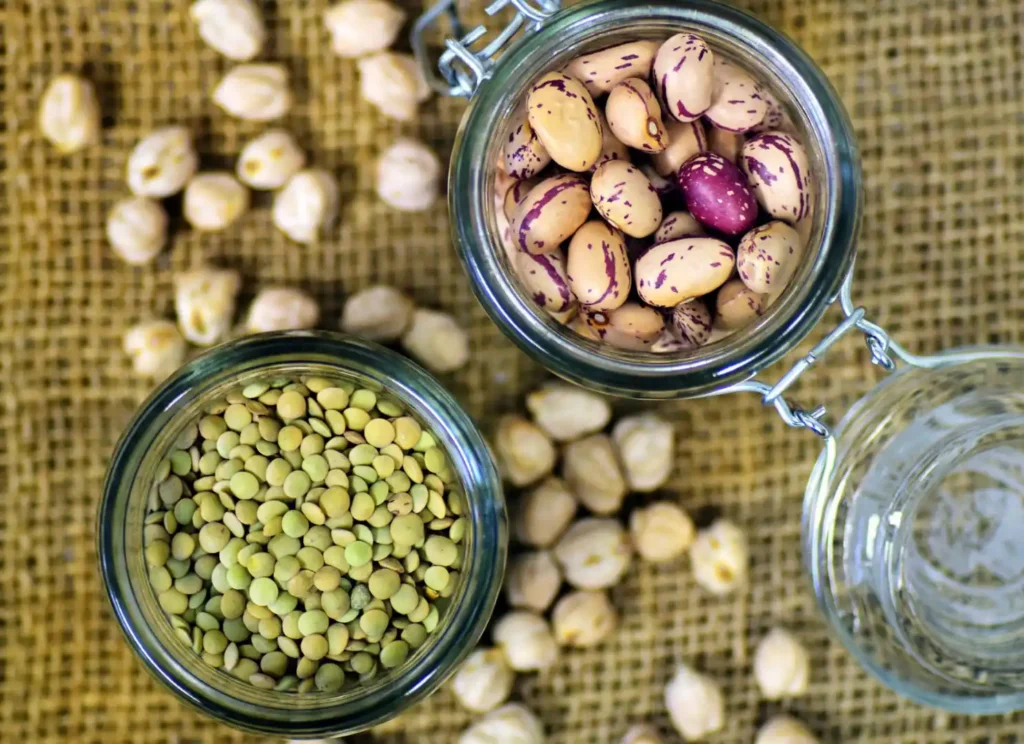
Do grains and beans feed strep? It is one of the most common questions I get from people healing from chronic illness, and the answer is not as simple as yes or no. Based on Medical Medium® information by Anthony William, this guide breaks down how gluten and non-gluten grains interact with strep and other pathogens, how beans and lentils affect the healing environment in the body, and what to do depending on the state of your health.
Key Takeaways
- Gluten-based grains such as wheat, spelt, and rye feed pathogens including strep. Clean grains like millet, quinoa, and gluten-free oats do not feed pathogens directly but can still be problematic for some conditions.
- Beans, lentils, and chickpeas do not feed strep directly but create a less ideal healing environment in the body when eaten in large quantities.
- Beans contain more intrinsic fat than commonly understood. While not an overt fat, this is worth considering when following a fat-free healing protocol.
- Sprouted beans, lentils, and chickpeas are the best form for consumption. When sprouted, their constitution changes and they behave more like a healing food.
- If you are stuck, plateaued, or in the middle of a flare, removing grains and beans entirely is worth considering.
- The Holy Four, fruits, vegetables, herbs, and wild foods, are the most supportive foods for healing chronic illness. Potatoes, sweet potatoes, squash, and green peas make excellent replacements for beans and grains.
So, I want to talk to you today about grains, beans, lentils, chickpeas, and strep. This is an area that confuses a lot of people who are trying to heal from various health symptoms. I repeatedly get asked: do grains feed strep? What about beans? Can I eat lentils and chickpeas when I have strep symptoms?
Do Grains Feed Strep?
Gluten-based grains, such as wheat, spelt, and rye, and even non-gluten grains like corn, feed pathogens including strep. Clean grains, for example millet, quinoa, and gluten-free oats, do not feed pathogens directly. The short answer to whether grains and beans feed strep depends entirely on the type of grain you are eating.
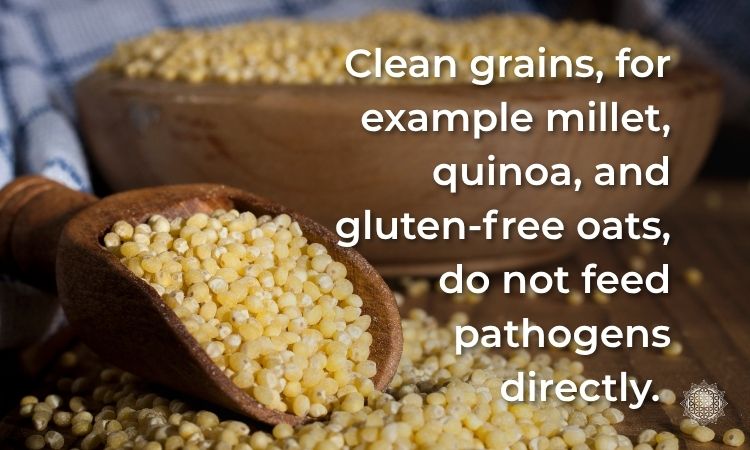
However, if you have COPD, recurrent UTIs, endometriosis, or asthma, it is best to eliminate grains altogether while you are healing. If you are healing from severe health issues like rheumatoid arthritis, scleroderma, sarcoidosis, spondylitis, eczema, psoriasis, or chronic fatigue, it is also a good idea to keep out even the clean grains.
Keep in mind that grains can create more mucus that can confuse the immune system for some people. Eating a lot of rice, for example, could potentially instigate a pathogen, meaning trigger but not directly feed it. Grains can be mucus-producing and hard to digest. They can cause confusion in the immune system and crowd out healthier, life-changing food choices.
Use your judgment and intuition regarding including grains in your diet when you are dealing with conditions like those mentioned above.
What If I Still Want to Eat Grains?
If you feel that you are healthy enough to eat grains or have other reasons for keeping them in your diet, there are healing foods you can include to improve the healing power of your meals. Remember: if you are stuck, plateaued, struggling, or in the middle of a flare, cutting out grains completely is an option to consider.
If you choose to eat grains, here are Anthony William’s recommendations:
- Choose clean grains like millet, quinoa, and gluten-free oats.
- Eat celery with grains. The mineral salts in celery make the grain release its potential phytochemical and chelate the grain.
- Eat cucumbers with grains to balance their acidity.
- Add spinach to your grain dish to help the body break down and use the amino acids.
- Eat lettuces such as watercress, arugula, sprouts, and microgreens with grains to neutralize acidity.
- Eat parsley and cilantro if you are concerned about arsenic, to help chelate it.
- Tomatoes are incredible with grains.
- Onions work synergistically with grains. Scallions and chives work great with millet, teff, and amaranth.
- Ginger is a tonic for the stomach to help utilize grain better.
- Turmeric enhances good amino acids in grains.
- Rosemary stimulates and strengthens digestion.
- Avocado is a good fat replacement for grains.
- Garlic phytochemicals bind to the grain and become one, working as bug killers.
Do Beans, Lentils, and Chickpeas Feed Strep?
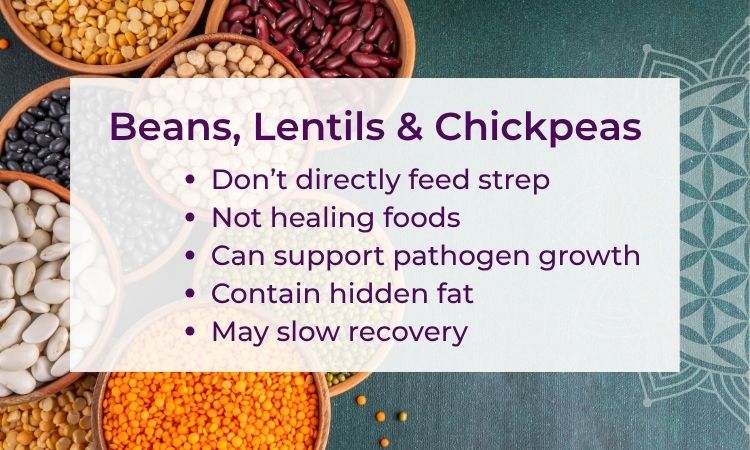
When people ask do grains and beans feed strep, beans are the part of the equation that trips most people up. Unlike gluten grains, beans do not feed strep directly. But they are not health-supporting foods either. Eating them in substantial quantities can provide a breeding ground in your body where strep and other pathogens can grow. They are not totally health-destroying. They sit in the middle. If you eat a lot of them and you are sick, they are not going to help you and could make the environment in your body such that it is harder to heal.
Beans, Lentils, Chickpeas and Fat: What You Need to Know
Every food contains intrinsic fat. All fruits and vegetables contain saccharides, amino acids, and fatty acids. Beans happen to contain more fat than most people realize. We think of them as a fat-free food, and while they are not an overt or radical fat, they are also not fat-free. Think about how satisfying beans feel when you eat them. That is a clue that they contain more fat than we assume. Lentils and chickpeas also contain fat, but not as much as beans.
To be clear, we are not talking about overt or radical fats. According to Liver Rescue, radical fats exist when the majority of a food’s calories are derived from fat. Beans, lentils, and chickpeas are often referred to as fat-free and are considered free of overt or radical fats. While they can be a better choice than some overt fats, this does not mean eating them is necessarily good for your liver.
Boiled beans are overt fat free. However, they do contain a higher level of intrinsic fat that is worth considering when following a fat-free healing protocol. Anthony William states clearly that we should avoid beans and grains when we are struggling with difficult conditions.
Side note: Green beans, sugar snap peas, and green peas are different from beans and lentils and are typically much lower in fat. Split peas are comparable to lentils.
What If I Still Want to Eat Beans?
If beans, lentils, or chickpeas are a regular part of your diet, there is no need to stress. There is a place for these foods in some people’s diets. In fact, there are recipes in Liver Rescue that contain these foods. They are not the worst options. An occasional quantity is fine to consume, depending on your symptoms and situation.
If grains and beans feed strep and you still want to eat beans, lentils, or chickpeas, here are the tips:
- Opt for sprouted legumes. This is the top choice. When you sprout, you change the constitution on the inside. The high fat in the seed and the carb is used to grow the plant. A cooked dry bean is very different from a sprouted bean. The green sprout that grows from the bean retains none of the qualities of the original seed and now has the qualities of green sprouts.
- Eat these foods in relation to the strength of your health. If you are in good health, you may tolerate them more than once a week. If you are in poor health or feel worse after eating them, avoid them.
- Keep a food diary when you eat these foods to track how they may be affecting you.
- Pair these foods with greens. For example, eat boiled lentils with a salad.
- Do not eat these foods with overt or radical fat. In Liver Rescue, Anthony William specifically recommends avoiding the combination of radical fats with beans, potatoes, and gluten-free grains.
- If you have liver issues, be careful. Opt for lentils or chickpeas as they are lower in fat than beans, and keep these to a minimum.
- Do not stress over this. If you feel you rely on these foods too much, start making small steps to reduce the amount you consume.
If Grains and Beans Feed Strep, What Should I Eat Instead?
I understand that once you learn that grains and beans feed strep and other pathogens, giving up foods that have been diet staples for years can feel overwhelming. But if you are stuck in your chronic illness or have plateaued on your healing journey, removing these less helpful foods makes room for more of the Holy Four.
If you want to reduce your grain, bean, lentil, and chickpea intake and bring in more healing foods, focus as much as you can on fruits, vegetables, herbs, and wild foods. Here are some suggestions:
- Potatoes, sweet potatoes, and squash are very satisfying and make great replacements for beans and lentils in recipes. Try adding them to salads, soups, wraps, casseroles, and curries.
- Green peas are low in fat and a versatile addition to salads and soups.
- Cruciferous vegetables can add heartiness to a dish.
- Cauliflower rice offers variety in texture.
- Steamed or roasted vegetables without oil can give your meal variety in flavors and textures. Try combining potatoes or squash with cruciferous vegetables, mushrooms, and your other favorite vegetables for a hearty meal.
- Bring in lots of fruit and lots of greens every day.
Discover what’s really holding you back from the healing breakthrough you’ve been waiting for. After working with over 11,000 people across 85 countries, Muneeza discovered that those who experience lasting healing aren’t just lucky – they understand these 4 essential foundations that others miss entirely.
Sign up for the FREE pre-recorded webinar “4 Essential Things Most People Miss in Their Chronic Illness Journey” with Muneeza Ahmed.